
Few who have encountered a gnoll will, at least during the encounter, be much concerned with precisely what sort of creature it is. Gnolls are undoubtedly among the most irascible and violent humanoids in the world. Ironically, among zoologists perhaps no humanoid has incited such animosity as the gnoll– not towards the gnoll, mind you, but towards each other. Those who have been attentive to zooethnology have always considered the gnoll to be, as the English portmanteau itself reflects, the descendents of a fertile hybrid of a troll and a gnome. Anyone with the slightest interest in the appearance of the monster, however– whether from experience in the field or with the specimens that are available at several museums (especially Mintwen Otoppali)– must insist on their resemblance to the hyena. Thus, most assiduous taxonomists and untutored warriors alike consider the gnoll to be a hyena-man, likely a magical combinature like the minotaur or centaur. In fact, as is often the case with longstanding scientific disputes, the truth is somewhat on the side of both camps, and yet neither is correct.
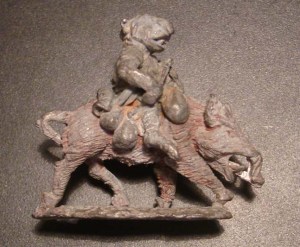
Fig. 1. Gnoll riding boar.
Retrosculptores, c.48 kya
Nearly three million years ago, gnolls originated as a tiny population of hybrids resulting from an invasion by trolls of an isolated and now extinct desert gnome race. Aside from gnawed and shattered bones, our best– indeed our only– representation of what these early gnolls might have looked like comes from the always extraordinary (but unfortunately irreplicable) finds of the so-called Retrosculptor cult that flourished around 48,000 years ago. Thanks to recent translations of Trex Etching, there can be little doubt that the figurine in Figure 1 is associated with the description “gnoll riding boar”. Nevertheless, gnolls were abundant during the period of the Retrosculptores, and we have copious independent evidence that the gnolls of that time looked very much like our familiar gnolls, and absolutely nothing like the individual in this sculpture. In this representation we see none of the distinguishing features of our contemporary hyena-like gnoll– the raised upper back, feline snout, shaggy hair including a dorsal mane, raised heel to permit either digitigrade or plantigrade stances (i.e., standing on the ball of the foot or the whole foot to the heel), and overall ungainly lankiness. Rather, this individual looks very much like what we would expect to see of the etymologically sensible but apparently nonexistent gnome-troll hybrid, with its hominid shoulder, elbow, and heel, a fleshy prognathic troll-face, and weak protruding gnome-ears. So, do we simply have a terrible sculptor here, or an instance of grossly mistaken species identity, perhaps supporting the occasional but recurring suspicion that the Retrosculptores were frauds? Or are there actually two different kinds of gnolls, that bear no relation to each other?! This is the matter about which historical zoologists have nearly come to blows (or have actually come to blows, if the rumors surrounding the notorious row at the Harpy & Flute in As-Infelt are to be believed).
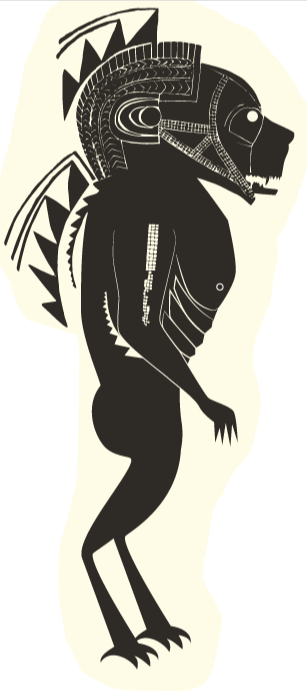
Fig.2. Bultungin.
Xoggi Desert, c.FLC 2100.
The solution to this conundrum has only recently come to light, the circumstances of which deserve some space here. Iyan Bel the Carnomancer, best known for recreating the manticore, conducted experiments on gnolls for several years, following his discovery that mutant gnolls are very occasionally born with more hominid features and nearly hairless– indeed, with about as much hair, and appropriately distributed, as we might expect for a gnome-troll hybrid. With the help of a hardy troop of adventurers, he was able to procure one of these mutant gnoll babies before it was thrashed on the rocks by its parents. He raised it to adulthood at his hermitage in Shola, and learned many things. Eventually he was able to acquire another and, now having one male and one female, he bred them. The offspring were as hairless and hominid-like as their parents.
As is well known, much of the wealth that funded Bel’s researches came from curing lycanthropism. One day, he was curing a human boy who had become what the desert people call a Bultungin– a werehyena (see the stylized representation in Figure 2). Bel was struck by the similarity between the afflicted boy, when in hyena form, and a typical gnoll. On a whim, he decided to infect both of the mutant gnolls with lycanthropism. As expected, they became werehyenas, as all hominids would; but to Bel’s great surprise their appearance was precisely indistinguishable from that of a typical gnoll. Moreover, whereas the mutants had been intelligent and placable ordinarily, in their wild phase they were now dangerously aggressive and showed no recognition of Bel; this is of course typical for lycanthropes… but also of gnolls! Strange to say, the wizard did not fully appreciate the significance of this transformation, being distracted with an epidemic of Xoggi sand sickness, until his assistant informed him one day that the female gnoll had again given birth, but this time to a hairy creature that was difficult to control. The Carnomancer rushed to the dungeon and, as he raised the pup in the air in front of his face, gasped with that astonishment that is known only to those who have made great discoveries. This thing too, like its recently infected parents, was indistinguishable from an ordinary gnoll. It was an ordinary gnoll.
Bel had discovered that gnolls are gnome-troll hybrids afflicted with a congenital and heritable hyenic lycanthropism. They are permanent werehyenas and pass this disease onto their offspring. Bel subsequently showed that although mutant non-lycanthropic gnolls were susceptible to any form of lycanthropism, they only passed the hyena form to their offspring, and in this situation the offspring would– for reasons still unknown– exhibit the wild phase constantly, from birth to death, rather than just occasionally such as under a full moon. Thus the creature we have come to know as the gnoll is, as the zooethnologists claim, a hybrid between a gnome and a troll; and, as is generally perceived, it is a sort of hyena-hominid combinature, though formed not by magic but by the interaction between mutation and a terrible infectious disease.
Such is the extraordinary history of the gnoll. The Carnomancer and his castle were destroyed by rhazah dragons soon after this discovery, and as Bel was widely considered insane, many of his claims, including those about gnolls, were ignored and forgotten. Not until the Psychomagists accessed posthumous traces of his lingering thought was this knowledge resurrected, and not until Jenghan recovered Bel’s logbooks from the lair of Kadax did it become available and credible to the world.
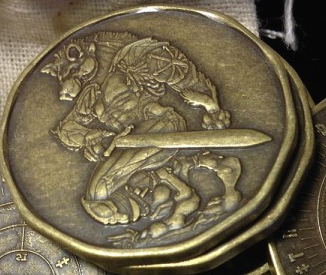
Fig.3. Sa’hvwahnian 20 eshni coin,
c. FLC 1574
Unusually for a hybrid species, the gnoll has proved very successful and adaptable, spreading easily to areas where neither of their parent species exists, and showing few of their habitat limitations. Gnolls do not retain many of the capabilities (such as flesh regeneration or ultraviolet vision) of either of their parent species. They have evolved for nearly three million years since their initial hybrid formation, and interbreeding has never been observed between gnomes and trolls, nor between either of these and gnolls. We can distinguish at least two species of gnoll (ignoring the flind, about which I confess I know very little). Wood gnolls are secretive, and mainly live in abandoned tree-houses of other species, since no gnolls themselves build. Rock gnolls are the familiar form, produce only sterile hybrids with wood gnolls, and are far more populous. Rock gnolls are the species known for aggressive cannibalism, scavenging, and periodic wars with humans and other folk. Rock gnolls, and presumably wood gnolls although they are less well known, are semirational, with primitive emotive vocalization that is only partially learned. They use weapons but cannot fashion them. They wear clothes but only as ornaments or displays to each other, particularly to advertise that they have killed a creature that wears clothes. They use money but can neither add, count over seven, nor barter.
In FLC 1540 the Sa’hvwahnians, ever appreciative of humanoid diversity even to their detriment, commenced minting of a 20 eshni coin featuring a gnoll on its face (Fig.3). The coin was in circulation for 131 years until the Flernak Wars of 1671-4, when the gnolls fought on the side of the fire giants against the humans and halflings. During this period, minting ceased and the Sa’hvwanian leadership gave their people five years to turn in their coins. In 1676 the last known remaining “gnoll coins” were melted and remain today as part of the brazing on the new wall of Vass, the sole city of Lissanya Sa’hvwahni.
Evolution:
Gnolls (genus Atrox) were formed de novo approximately 2.9 mya, in the late Vincan or early Hallarian Age, by the hybridization of primitive gnomes and trolls. Although contemporary gnomes are disgusted at this relationship, they should be reminded respectfully that (1) gnomes have undergone an astounding degree of evolutionary change in the interim, (2) the appearance and nature of gnolls is arguably governed more by their endemic lycanthropism than by either ancestral hominid stock, and (3) the race (or species) of gnome that was involved in the hybridization went extinct at about the same time as that event, perhaps even as a result of the interaction, and thus has left no gnome descendants. The two parental groups that led to the formation of gnolls, namely the Mutili (trolls) and the Dwergar (gnomes, dwarves, lencers), had themselves diverged only about 300-400 ky earlier, which explains their lingering interfertility. Thus the common ancestor of all three groups lived c. 3.1 mya, in the early Vincan Age. The common ancestor between gnolls and humans lived c. 3.6mya, in the middle Euhominian, at the split of the Homoans (Homo) and Subterranei. The transition from the original gnome-troll form to the hyena-like form is estimated to have occurred about 0.7-1.2 mya, although this is highly uncertain. We do know that by the time gnolls were represented in art around 75,000 years ago, only the hyena-like form is represented, until the Retrosculptores perceived a different form (via their magical access to the past) approximately 48,000 years ago.
Kosmos (κς) connections:
The “gnole” entered into κς culture in a Lord Dunsany, Edward Plunkett (1878-1957) story “How Nuth would have practiced his art on the gnoles”, from his 1912 work The Book of Wonder: A Chronicle of Little Adventures at the Edge of the World. He does not discuss the gnoles extensively. He mentions that they live in a strange forest of trees that seem unwholesome, and particularly adopt high narrow houses, perhaps even modified trees since they spy on Nuth out of holes they have carved in trees. The gnoles are fearsome, abducting the burglar Nuth’s companion and dragging him to an unknown but terrible demise, portrayed by the illustrator Sidney Sime (in the Featured Image– by the way, apparently Sime’s illustration preceded and partly inspired Dunsany’s story). Finally, the gnoles tend to place emeralds above their doors, the very gems Nuth was hoping to steal. Gary Gygax, some time before AD 1974, marvelously (and characteristically) intuited the relationship between gnomes and trolls in this creature, and respelled it “gnoll” to more clearly represent this relationship. Later, in accordance with the general trend, the hyena resemblance was overemphasized, even to the extent (though unsubstantiated by any observation) of claiming companionship between gnolls and hyenas. The flind has been considered since AD 1981’s Fiend Folio to be a race of gnoll, or alternatively a related species to gnolls. Flinds are shorter and stockier, and are said to use a weapon like the nunchaku.
κς replicas and image curation provided by the following:
- Fig. 1: Gnoll riding boar: Fantasy Tribes (1980): http://realmofzhu.blogspot.com
- Fig. 2: Bultungin: Ken Wilson-Max (2013): http://theillustrationist.com
- Fig. 3: Gnoll coin: Rare Elements Foundry (replicas available for sale!): http://rareelementsfoundry.com
- Featured Image: “The lean, high house of the gnoles”, illustration by Sidney Sime (1912).

 Myrstat