
“Through tortuous crevices in the deep earth, where all light is banished, creatures pass quietly in tight spaces. They flow like slow water through winding channels with hoarse scuffs and slides. Those that draw themselves along most continuously, that most expertly extend their senses forward and alongside and backward, those hindered the least by jutting root and sharp embedded stone, are the soft tube animals. The worm. The grub. The larva.
High above, furthest from that cramped blackness in all ways, expands the open profundity. Here are no tunnels, no paths, no mark or guide or hindrance along one’s way. Direction is sundry. Distance is as brief as thought. From these skies, the hard ground that anchors so many can but softly lure those who climb and soar and reel. In this rare world rest those that float on blue nothing. Here strive those that pierce the wind, and reign from it.
Of all the beings ever to probe new spaces, to explore the extremes of dimension, only one has mastered both of these domains, the deepest hole and the brightest sky.
The snake.
The legless ones conquered first the subterrain. After 150 million years, those that writhe and slither have become the most universally dreaded of earthy predators: as quick to kill as the lion, yet as secretively lurking as the spider. Fewer know that they also stalk from the air: seldom seen, never heard, and only felt as needles from gaping jaws. Their wings are sleek membranes, raising up their sinuous forms on the slightest breeze, but folding to a mere skin along their backs as they dive into their holes with the swiftest slip.”
~Massenos of Karta, Lepidosauriana iv.38.
With this passage, the famous zoologist introduced the flying serpent to the learned circles of Tethrent. Amphipteres had long been known to less scholarly folk, however, especially in the fount of their diversity in northern Rhéat. Far from “seldom seen”, a traveler just south of the Silver Daggers would hardly escape noticing the nightly writhing sparkle of swallow-snakes over shallow ponds. Even in the populated areas north of the Daggers, the dense kettles of raptors spiraling above the foothills actually include soaring snakes among the hawks and eagles. Massenos did know well the venomous bite of the sicula, however, so we should excuse him for the sensationalism with which he ends his encomium. In fact most flying serpents are not likely to bite humans unless they are caught or handled.
Amphipteres (family Pterophiidae) are remarkably successful, having radiated into nearly 300 species (nearly 10% of all snakes on Zomme) and occupying nearly every reptilian niche in warm and temperate forests. Nevertheless they are among the most misunderstood of all creatures. Even when they are seen, except where they are very common their fleeting shapes are generally mistaken for dragons, bats, or birds. The larger amphipteres are therefore assumed to breathe fire, and the smaller ones to be harmless. Neither is true– no amphiptere employs fire, although a few do spit venom; and the electric “flying threads” are perilous but are among the smallest of all snakes. Our familiarity with dragons is surely the cause of most of the confusion, on several fronts. Dragons have often been called “snakes” or “serpents” because of their elongated reptilian body form. The fact that many dragons fly has led somehow to the assumption that all flying featherless reptiles are dragons, including wyverns, pterosaurs, fellbeasts, and, alas, amphipteres. Even among dragons that do not fly, some are limbless, and on this account they are frequently mistaken for snakes. The basilisk, which is a snake, is frequently thought to be a dragon. On the other hand, no less a glossarist than Fa-Ontich once wrote (as always in an attempt to simplify language, even at the expense of accuracy), “Limbless reptiles on the ground are snakes” (Deonticon xliv.34). Perhaps, with all due respect, the esteemed Bnirkish sage would have us consider all red flowers roses and all winged creatures butterflies. From confusions in the air and on land we can add muddles on the open water, for mariners throughout history have used “sea monster”, “sea snake”, “sea-dragon”, and other terms more or less indiscriminately for vermiform marine animals of various types. In fact, the giant fearsome “sea serpent” that recurs throughout the mythologies of Zomme is neither dragon nor snake, but a limbless plesiosaur. Undoubtedly we can sympathize with the seaman who recoils from a massive monster rising from the abyss. Its precise identity is not the primary concern.
Flying serpents… and others
Any discussion of amphipteres must therefore set the record straight as to what these enigmatic organisms are, whence they evolved, and how to tell one when you see it (or are bitten by it!). Briefly (but not perfectly), an amphiptere is a winged snake. This is indeed what the Raddenon word for the creature most closely means, and after consulting the relevant Kosmos Konnexions the word “amphiptere” has been considered the best term to translate it. It can generally be assumed to be synonymous with “winged serpent”, “flying snake”, and the like, although see below for one major exception.
Before considering further the flying snakes, we should establish what a snake is. A snake is a member of a clade of legless organisms (specifically, Serpentes) that descended from ancient lizards in a single event around 150-200 million years ago. Snakes represent just one occurrence of the loss of all four limbs among many (at least 28) such instances in the history of reptiles. Among the legless lizards they can be considered by far the most famous, and most successful in terms of numbers of species or of individuals. We shall consider them separately from lizards here, for simplicity and specificity. This is important for the sake of understanding dragons as well: dragons are likewise derived from lizards, and represent at least three additional instances of the evolution of leglessness.
Snakes are elongated, legless reptiles with flattened scales (not horny or sharp or raised), and forked tongues. As they originally evolved underground, they lost not only their limbs but their ear holes, eyelids, and any protuberances on their bodies, such as crests or wattles. The following table distinguishes the presence or absence of certain traits in three groups of legless reptiles. The “legless lizards” here are considered to be all those except, of course, the snakes and dragons. Among all reptiles (and for that matter all amniotes), this table therefore covers all instances of leglessness excepting only the monotypic legless pleiosaurian sea monster.
| Snakes | Legless Lizards | Legless Dragons | |
| Forked tongues | All | None | Some |
| Second row of teeth on palate | All | Some | Some |
| Extremely maneuverable jaws | All | None | None |
| Eyelids (blinking) | None | Some | All |
| Ear holes | None | Some | All |
| Crest | None | None | Some |
| Horns | None | None | Some |
| Tail autotomy | None | All | None |
| Speech/Rationality | None | None | All |
| Wattles | Some (only flying) |
None | Some |
| Burrowing | Some | Some | None |
| Aquatic | Some | None | Some |
| Magic | Some | None | All |
| Breath/Spewed weapon | Some | None | All |
| Gliding | Some | None | None |
| Flying | Some | None | Some |
Note that some snakes and legless lizards have lost their burrowing ability despite having originally evolved underground, and no dragons have ever burrowed (hence the common presence of wattles, crests, horns, and other features associated with surface dwelling). Some snakes can spew venom or acid, but none of them have the incendiary breath of some dragons.
Amphipteres being flying snakes, they adhere to all of the features that are generally true of snakes, except that they also have flight and associated morphology, and some have wattles. By flight is meant powered flight, the ability to propel oneself through the air and consistently maintain velocity and altitude, such as with wings or winglike structures. Thus we can recognize three more things that amphipteres are not. First, they do not include the monotypic jaculus, also known as the javelin-snake, javelot, or darter (not to be confused with a bird that shares that name). The jaculus is a wingless snake, known for its habit of leaping from trees and stiffening to pierce its oversized prey with its arrow-shaped tail. Secondly, amphipteres do not include the gliding snakes (genera Chrysopelea and Praetorlabor), which lack wings, and do not properly fly, but are nevertheless sometimes nicknamed “flying snakes”. These on Zomme are known as “ribbon snakes”. They flatten out their bodies as they jump from tree to tree in tropical rainforests. These remarkable snakes have evolved their habits thoroughly independently of the amphipteres.
No snakes have feathered wings. Feathers are found only on dinosaurs (including birds) and combinatures involving dinosaurs (e.g., griffon, cockatrice). Of course, many ethereal (spiritual) beings can manifest in a physical form, and feathers are reputed to be common choices for such avatars. The one that could be most easily confused with an amphiptere is Quetzlcoatl, or the “plumed serpent”. Only one record exists of a manifestation of Quetzlcoatl on Zomme (Don Din, Rhéat By Boat And Sword xii.1), and Din indeed described it as a “winged serpent thoroughly covered with plumes”, by which he meant long loose feathers without barbs.
Because flying serpents are so beset with misunderstanding, this summary has already been overladen by references to evolutionary history and trait specificity. Still, as the ancient poet said, “The prayer is stained of the man who cannot name his meat.” (anonymous, 6th-7th century FLC, Gyun Empire (present-day Principality of the Lockë)). So we hope to be excused for belaboring these matters. Just one more distinction is necessary before settling safely in the realm of the amphiptere. As if to dismay even further those who hope to understand reptilian diversity and complexity, not one but two lineages of serpents have evolved wings. First, nearly 130 million years ago, amphipteres evolved from gliding tree snakes. That is our present story, more of which will be told in a moment. However, a mere 15 million years ago, another trajectory commenced, in a different lineage of snakes altogether. As is well known, the cobras, either to compete with each other or to scare away predators, have evolved a spreading hood that involves the coordinated action of scaled skin, underlying muscles, and even ribs. This hood increases the apparent size of the cobras when they are threatened. Considering the terrifying effect this hood has on humans, one can only expect it has been at least equally effective on other snakes and on predators. Hood-forming cobras have diverged into two equally notorious and iconic lineages in the tropical to warm temperate regions of Zomme. The one of these lineages that resides on Rhoghón-thozimo, or the Wild Continent as it is called by the Tonel, has diversified into a variety of forms and colors, including some whose hoods extend more than halfway down their bodies and stretch at need to more than thrice the width of the snake at rest. From such ancestors at least two species of flying cobra (Pterotonaja) evolved. Their wings are extensions of the hood into a broad, thin flap along nearly the entire length of the body, lined with flattened ribs that are only partly ossified and remarkably flexible. They are weak fliers, require a leap from a height to get started, and locomote by a combination of flapping and undulation. Their venom is notoriously potent. They are non-magical.
Amphiptere natural history
1. Evolution & morphology
Very early in snake evolution, a lineage of proto-colubrid tree snakes possessed reduced limbs, though not entirely as reduced as they are today. The hindlimbs had shrunk nearly to today’s mere claspers, but the forelimbs were slightly evident bumps, under which remained tiny bones that had not yet been completely lost. The pectoral girdle that anchored the forelimbs of the ancestors of snakes had not been completely lost either, and still articulated with the small forelimbs. From this snake lineage (or one closely related to it), eventually, the amphipteres evolved. All amphipteres today have two well-developed, scaleless, membranous (skin) wings, resembling those of a bat. Each wing is supported with a short humerus; a long, flattened ulna (outer forearm bone), and four greatly elongated digits of the hand. Thus, when we speak of snakes as being all legless, this does not mean they are all limbless! The amphiptere is the exceptional snake in having regained its forelimbs, in the form of wings. No other snakes have regained any limbs.
Many amphipteres have one or more claws that protrude from each wing where digits end; these are often used for climbing, and in some (the spurwinged snakes) for competition among males for females.
Most amphipteres are small, some even fitting in the hand, but the largest ones (pelagic gliders) reach up to 5 feet in length.
In continental areas, amphipteres have moderately high rates of speciation (similar to the colubrids from which they descend). However, they have undergone adaptive radiations on at least two island chains, most notably the Isles of Kurr, where different islands boast different arrays of species, including one or sometimes more than one endemic species per island.
Ecology
All amphipteres are either diurnal or crepuscular. Most spend the nights in burrows, either underground, in holes in trees, or in crevices among rocks. They do not excavate, but take advantage of existing spaces (including those dug by their prey). Some do not use burrows, but rather hang from trees at night like bats, wrapping their tails over limbs. Those that do use burrows lay their eggs in them; those that do not, lay their eggs usually in small nooks where a tree limb meets the trunk. No known amphipteres bear live young. A significant minority (perhaps 25%) care for their young by bringing them food after they hatch. This is remarkable, and unique among snakes. The only other snakes known to care for their young after hatching are pit vipers (Crotalinae), but this does not include food provisioning.
Habitat & Movement
Forests are by far the most common habitat for amphipteres. Many are proficient tree climbers (whether with or without wing claws), and are dextrous gliders and fliers in forested environments, often wheeling and darting between trees, rotating their bodies in a flash to fit their wings between narrow openings, and landing parachute-style with remarkable precision on branches or prey. Amphipteres tend to have a slender, ribbon-like body form, and actively flatten out their bodies in flight. Most cannot fly easily after a meal. No stocky or viper-shaped amphipteres are known.
Most amphipteres cannot launch into flight unless they have gained at least a few feet in height above the ground, but all have powered flight once aloft. One of the exceptions to the typical top-down mode of take-off is the flying racer. It can reach high speeds in open areas, and suddenly reel up into the air like a kite by casting its wings upward and outward.
Some amphipteres soar, occasionally even taking advantage of the same thermals and updrafts as hawks and eagles do; these species often have flattened tails. Some pelagic varieties have long wings and a much reduced tail. These trenskeers, or “fish-snatchers”, make extended gliding journeys along the open ocean, and dive to catch their prey on or just below the water’s surface. These and other larger amphipteres usually start flying by climbing up cliffs, often with the aid of wing claws.
Predation & Defense
All flying snakes, as indeed all snakes, all legless lizards, and all dragons, are carnivorous. Most amphipteres feed on animals on the ground or on tree branches, approaching them initially the way falcons do– by collapsing the wings and diving upon them. As they near the prey, they embark on one of two general strategies: head-first if low-speed (as from a short distance), and tail-first if high-speed (such as from a distance). Some species employ only one of these strategies, but most are capable of both. A head-first attack is an immediate bite, in the manner of most earthbound snakes, although in some cases the amphiptere continues to fly or glide for a short time with the prey in its mouth. The tail-first attack involves two stages: first the snake rapidly revolves or jackknifes from a head-first to a tail-first orientation and impacts the prey with the full weight of its body, usually coiling the tail just before impact, with wings protected behind them. This event alone often disorients or even kills the prey. The second stage is of course the bite, which follows immediately. Some amphipteres ingest their prey directly from that initial bite, whereas others release and bite again more carefully, or even slither or fly away with the prey.
Some amphipteres have more specialized predatory tactics. The “swallow-snakes”, named after the birds they resemble, are mostly small and insectivorous. They have modified jaws that can open to up to 140 degrees, with which they catch their insect prey from the air in flight. Other, larger amphipteres snatch birds or other amphipteres in the air. Some specialize on certain kinds of prey, such as squirrels, lizards, other amphipteres, and small birds. No known amphipteres are sit-and-wait or ambush predators, as they have difficulty moving quickly from a start. All therefore hunt actively, through constant moving and searching. Unsurprisingly, amphipteres have evolved much more acute vision than their nonvolant relatives.
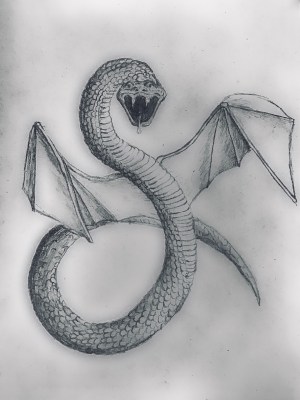
Figure 1. Fanged amphiptere. Asher Cerator, FLC 2487, Ferleventó, Mighty Woods.
I must boast that my son, the magicozoologist Asher Cerator, recently discovered and described the first amphiptere with venom delivered by hollow fangs. (Indeed, this is the reason I chose to write this essay!) Asher caught the snake in a sack as it hung sleeping from a tree limb, and transferred it (flapping, hissing, and striking madly) to a cage. He drew a likeness of the marvelous beast with charcoal on inner fyorlsket bark (Figure 1). We can see that it is an amphiptere and not a flying cobra, as its wings are supported by forelimbs rather than ribs. Very few amphipteres are venomous, and until Asher’s discovery the only ways they were known to deliver it is either along short grooved back fangs, or by spitting. See the bottom of this post for more concerning Asher.
Electricity & Magic
At least three lineages of electric snakes exist on Zomme, all of which are amphipteres. The flying threads are among the smallest of all snakes, able to fit coiled in the area of a coin. They deliver a magically fueled electrical impulse that can kill a human instantly. Their wings flap so quickly that they make a droning sound not unlike a large bug, that is often taken as a warning by people who frequent their habitat. Fortunately, the flying threads’ first reaction to a potential threat is usually avoidance, and they do not hunt large prey. Their electrical discharge is solely a defense, as they do not use it to subdue their tiny prey of insects and worms. All other electric amphipteres, on the other hand, do shock their prey.
Electric amphipteres tend to be unusually slender snakes, and typically inhabit dense forests, where they must attack their prey from a short distance. In such habitats, amphipteres have difficulty subduing their prey by more conventional means. Unlike the flying threads, which deliver their shock instantly upon touch from any part of their body, all other electric amphipteres deliver the shock with a bite, through a highly conductive salivary mucus. When they catch prey or attack a predator, the shock is delivered after a small delay following the bite (usually 0.25 to 1 second). Often trekkers in forests are able to feel bites and yank the snakes off of them (electric amphipteres have short teeth) before receiving a shock. The snapping sound of the shock is familiar to travelers in forests inhabited by electric amphipteres. The shocks are rarely fatal, but can be serious depending on the relative size of the biter and bitten, and the location of the bite on the body. With the exception of the flying threads, the shocks of electric amphipteres are non-magical.
The magical ability most common among amphipteres, although present in only about 15% of the species, is known as the “zip”. In these species, individuals in flight are able to burst forward with sudden speed for a very brief time. Often during this event the wings hiss briefly with an audible “zip”. For centuries, since this ability was discovered, it was thought to be somehow natural. However, Asher Cerator proposed and later proved it to be magical, just 7 years before I write this.
Several species of amphiptere are endowed with magical resistance to fire, and at least one is a (magical) hyperthermophile, living in active volcanoes. On the other hand, ice amphipteres (which tend to live in the moist tropics, not cold areas) have magically supercooled mucus that freezes most small objects it touches; they wield this as a spewed weapon to immobilize prey and ward off potential predators. The metabolism of ice amphipteres is regulated magically.
There are no invisible flying snakes, none whose gaze is injurious, and none with magically endowed speech or other intelligence. Aside from their modest array of magical abilities (whose sources are thoroughly unknown), amphipteres are apparently thoroughly natural. They are involved in no known combinatures.
Further Reading
Our most extensive resources regarding the natural history of amphipteres on Zomme are Fyrön, Explorations ii.34; Mesclirio, Poems of the Observed, series F; and (surprisingly) The Psychists, Journals clxxiv.
Featured Image: Scales of the golden flail, Chrysoflagellum kurrensis, an attractive amphiptere endemic to Prettl, Mirtont, and North Devvik, three of the Isles of Kurr. Courtesy of Vleriss Cerator.
Guest Artist: Asher Cerator is a maker of potions and magical weapons, and specializes in the appropriation of natural ingredients, particularly from animals. His work therefore involves zoology, blacksmithing, and spellcasting. Asher discovered the fanged amphiptere during an expedition for another species whose venom he wished to use in the construction of a potion.

 Myrstat